
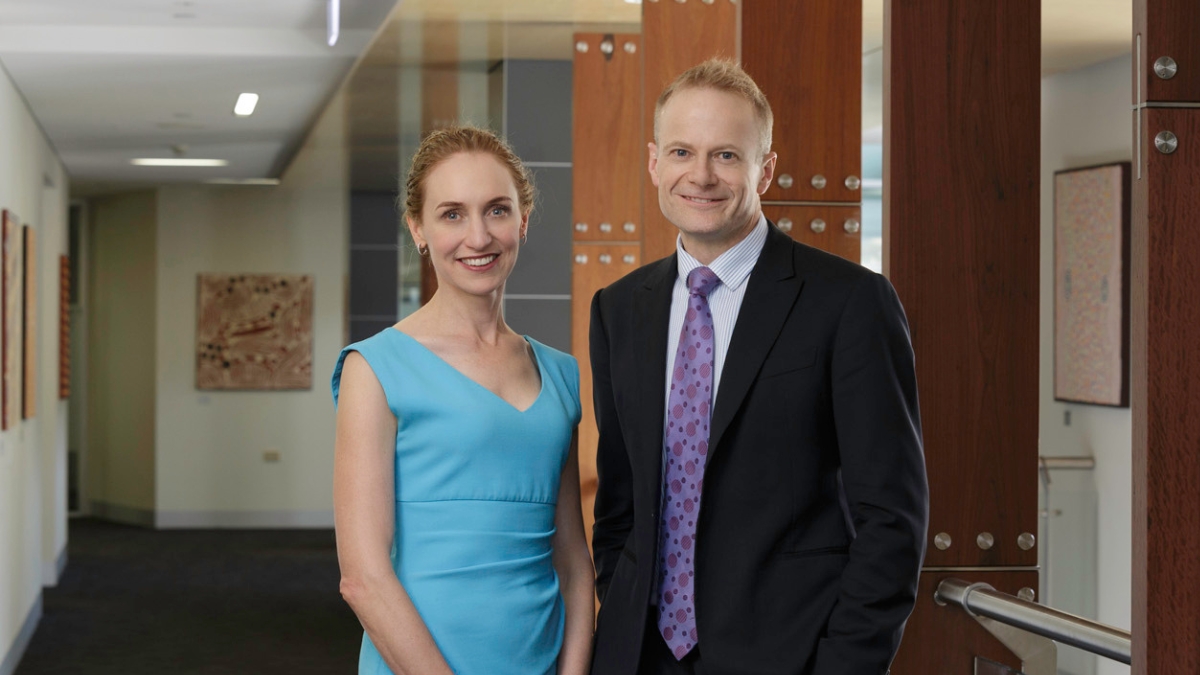
As published in The Australian, Prof Richard Scolyer AO’s friends and colleagues, Professor Georgina Long AO and Dr Kerry Crotty, share their reflections on Richard’s extraordinary spirit, his exceptional contributions to the fields of melanoma and pathology, and his lasting legacy.
This article was first published in The Australian on Saturday 11 July and reproduced with permission.
Richard Anthony Scolyer AO, our beloved friend and colleague, died on June 7, 2026, at the age of 59.
Richard was a truly extraordinary pathologist – a “pathologists’ pathologist” – who also made generous time for clinicians navigating complex diagnostic cases, understanding that an accurate tissue diagnosis was critical to patient care. His knowledge was vast, his skill exceptional, and he had an unparalleled eye for accurate tissue diagnoses and the precision to apply decades of experience where it mattered most. He shared that expertise widely: through consultation on external cases, through diagnostic and classification frameworks now used worldwide, and as a devoted teacher and mentor. His collaborations that delineated the origins and growth patterns of melanocytic tumours transformed how clinicians understand and manage these lesions at diagnosis.
The Melanoma Institute Australia multidisciplinary team meeting is known the world over for its focus on the most complex melanoma cases. Within that room full of expertise, Richard brought something no one who attended would forget. He did not simply present pathological findings; he made them come alive. In earlier years he would sit at his microscope, linked to the screen, walking the room through each tumour’s features with extraordinary care. In later years, as co-chair, he would turn to junior doctors and fellows mid-meeting, asking questions, waiting with obvious delight for the moment something clicked. When questions came back to him, he answered with the same energy: never perfunctory, always generous. Many describe him as the finest pathologist they had ever encountered.
Richard had an adventurous Launceston childhood with parents Maurice and Jenny, and older brother Mark. After attaining his medical degree (MB BS) at the University of Tasmania, Richard trained to specialise in anatomical pathology, first at Canberra Hospital and then Royal Prince Alfred Hospital (RPAH) NSW, receiving his specialist registration in 2000 when he became a Fellow of the Royal College of Pathologists of Australasia (FRCPA). Richard then received the inaugural Melanoma and Skin Cancer Research Institute (MASCRI) Pathology Fellowship in 2001, instigated by Dr Kerry Crotty a pathologist at RPAH and Sydney University: she advocated for the vital role a pathologist plays in melanoma and cancer research. The position was supported by the MASCRI director Professor William McCarthy AM, a surgical oncologist who was the then deputy head of the Sydney Melanoma Unit (now Melanoma Institute Australia, MIA).
This began a lifelong journey in tissue pathology and diagnostic oncology of the skin, especially melanoma, and medical research. During this time Richard was also mentored by pathologist and melanocytic tumour expert Professor Stanley McCarthy AO, whom he later described as “a legend and an icon in the Australian pathology community”. Richard modelled his life as a pathologist on the example and skills demonstrated by Stan.
He also worked closely with surgical colleagues, including Professor John Thompson AO, correlating pathological findings with disease natural history. Richard submitted this body of work, titled The Pathology of Melanocytic Tumours: Diagnostic and Prognostic Features, to the University of Sydney and was conferred with a Doctor of Medicine in 2006.
His life’s work in pathology took him to remarkable heights. He became one of the world’s leading melanoma pathologists and an authority on the classification of melanocytic tumours, contributing to the World Health Organisation’s definitive standards in the field, and was a passionate advocate for the role of pathology in medicine and disease. Central to that mission was his work refining the melanoma staging system through the American Joint Committee on Cancer and he was appointed vice-chair of its Melanoma Expert Panel in 2013, ensuring that the pathological diagnosis and classification of melanoma translated meaningfully into patient care and clinical outcomes. His contributions have been recognised with numerous prestigious awards, including Distinguished Fellow of the RCPA in 2020 and most notably two lifetime achievement awards in 2023: the Society for Melanoma Research and the American Society of Dermatopathology; and joint Australian of the Year 2024 with medical oncologist Professor Georgina Long AO.
Teaching, mentoring and supporting others were a huge part of his life. Richard enjoyed seeing junior researchers and clinicians succeed, and their ideas and visions to be realised. After being awarded the first of many NHMRC grants in 2006, he commenced mentoring research assistants and PhD students to careers in medical research. Richard established a research laboratory at Gloucester House, RPAH, focused on understanding the genetic makeup of primary melanomas and how specific tumour features seen under the microscope could predict patient outcomes. He also co-led the Australian Melanoma Genome Project – a comprehensive genomic analysis of melanoma – and was lead pathologist for the National Institutes of Health US-funded The Cancer Genome Atlas melanoma project.
By the time the laboratory moved to the Charles Perkins Centre at the University of Sydney, it was co-led with Professor Long, whose drug development expertise and therapeutic translational focus had expanded the program’s reach. Together Richard and Georgina became co-medical directors of Melanoma Institute Australia in 2017, the world’s largest centre for the research and clinical care of people with melanoma. Richard continued his role as a senior diagnostic pathologist in the department of tissue pathology and diagnostic oncology at RPAH, where he mentored the next generation of pathologists.
His support vitalised projects. He had worldwide collaborations with world-class melanoma research institutes. At MIA, Richard had a rare ability to infuse projects with possibility, lend them weight, and provide space for them to flourish. He understood the vision others held and helped bring them to life. Richard was patient, kind and generous, with the rare ability to provide advice without prescription. Those he supervised and collaborated with remember with emotion his generosity without reservation – always available, always willing to explain and support, always genuinely delighted by their progress.
Richard had a joyous and competitive spirit. Sport and exercise were his lifeblood; his love and pride in his local parkrun equal to that of representing Australia in the Triathlon Multisport World Championships. His competitive nature and drive to succeed were integral to his life.
Richard was diagnosed with a glioblastoma, an incurable brain cancer, in May 2023.
Richard chose to share his cancer journey publicly, and the outpouring of support and hope that followed sustained him. In addition to being named Joint Australian of the Year 2024, Richard received numerous honours following his diagnosis, including a research award in his name from the Royal College of Pathologists of Australasia and an honorary doctorate of medicine from the University of Sydney.
The International Academy of Pathology Australasian Division (where he served as president from 2015 to 2017 and received the Distinguished Pathologist Award in 2023), established a run/walk at their annual scientific meeting in his honour.
Despite all his accolades and distinguished career, Richard always said that his greatest achievement and love was his family.
After three years, Richard passed away surrounded, cared for and loved by family, living with his singular passion and vigour until the very end.
Richard is survived by partner Katie, children Emily, Matthew and Lucy, parents Maurice and Jenny, brother Mark and extended family.
He will be greatly missed by family, friends, colleagues and the Australian wider community.
Written by Professor Georgina Long and Dr Kerry Crotty.
Professor Georgina Long AO is medical director, Melanoma Institute Australia; professor of medical oncology and translational research, University of Sydney; medical oncologist, Royal North Shore and Mater hospitals. Dr Kerry Crotty is a pathologist and dermatologist.

Thank you for this excellent summary of Professor Scolyer’s considerable achievements in life. We are grieving his tragic loss but are grateful that he lived to help so many of us survive melanoma. We are sorry that he has succumbed to his illness at such a young age. He had so much more to give us all. Special thoughts go to his brave wife and children. They did him proud today at the beautiful memorial service .