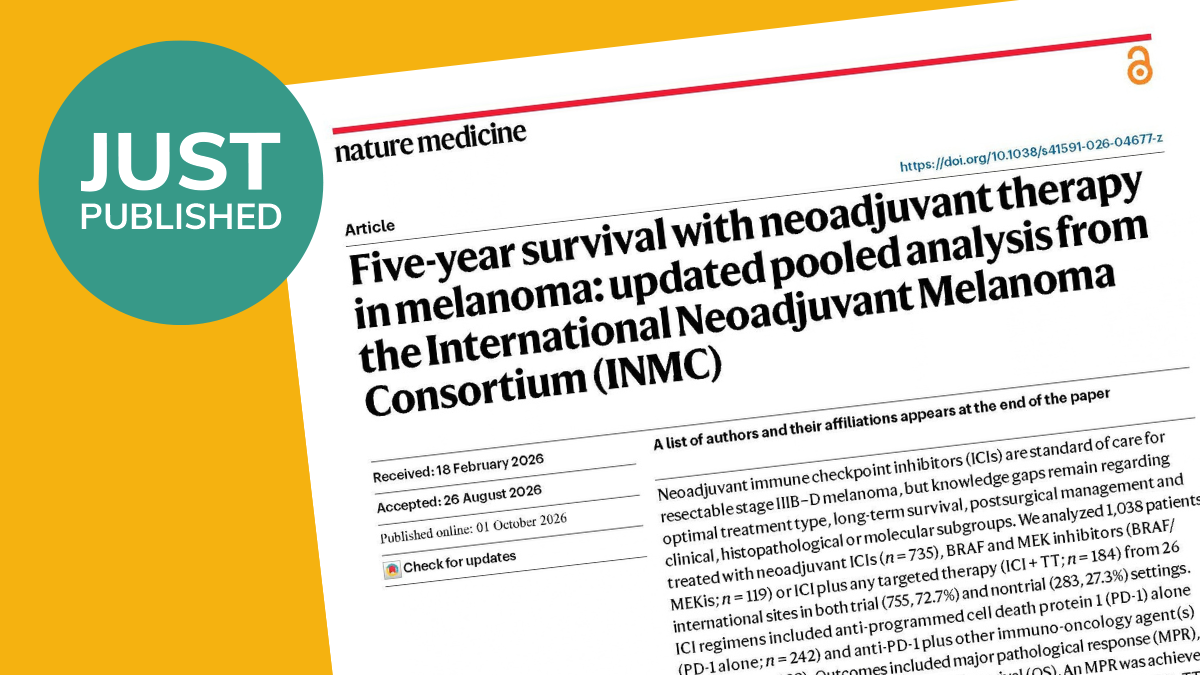
An international study led by Professor Georgina Long AO has been published in Nature Medicine, providing the first five-year survival outcomes for patients with melanoma treated with neoadjuvant therapy in clinical trials and routine practice.
The study Five-year survival with neoadjuvant therapy in melanoma: Updated pooled analysis from the International Neoadjuvant Melanoma Consortium (INMC) analysed retrospective data from 1,038 patients across 26 centres worldwide with stage IIIB-IV cutaneous melanoma, including acral melanoma. Patients received neoadjuvant (before surgery) treatment with immunotherapy, targeted therapy, or a combination of both.
The results provide strong evidence that the promising outcomes seen in clinical trials, including NADINA, are translating into real-world patient care.
“This pooled analysis of five-year survival outcomes confirms what we’ve hoped: trial results translate into everyday practice.
Patients whose tumours responded well to immunotherapy before surgery had outstanding 5-year survival.
Our next step is to identify who needs less treatment (avoiding unnecessary toxicity) and who needs a different approach. This is real progress toward personalised care.
Deep thanks to our incredible global team of collaborators.” – Prof Georgina Long
Patients whose tumours had a major pathological response to immunotherapy before surgery had exceptionally high five-year survival rates – 98.8% for those treated with PD-1 therapy alone and 97.9% for combination immunotherapy.
Importantly, patients who achieved a major pathological response did not appear to gain additional benefit from continuing immunotherapy after surgery, highlighting the potential to reduce treatment and avoid unnecessary toxicity for some patients.
The study also found that neoadjuvant immunotherapy was effective across melanoma subtypes traditionally considered more difficult to treat, including BRAF-mutant, acral, in-transit, and oligometastatic (where disease has spread to a limited number of locations in the body) melanoma.
The next focus is identifying, as early as possible, which patients can safely have less treatment, and which patients require a different approach because their melanoma is resistant to immunotherapy. This is an important step towards more personalised care which is now being explored in the NeoIRENIE clinical trial.
Professor Long acknowledges the incredible global team of collaborators who made this important study possible.
The International Neoadjuvant Melanoma Consortium (INMC) was established to bring together key stakeholders across multiple disciplines including medical oncology, surgical oncology, pathology, radiology, and translational research from institutions around the world with the goal of creating an organised approach into the investigation of neoadjuvant treatment in melanoma.
Other authors from Melanoma Institute Australia faculty and team include Assoc Prof Ines Pires da Silva, Kristen Perry, Prof Serigne Lo, Assoc Prof Matteo Carlino, Assoc Prof Alexander van Akkooi, Dr Robert Rawson and Prof Alexander Menzies.
Read full story, including the full listing of authors and their affiliations from 26 centres worldwide.
Melanoma Institute Australia is affiliated with The University of Sydney.
Leave A Comment