It’s not just how many immune cells are in a tumour. It’s where they’re located and their type.
When immunotherapy works, the results can be remarkable. Drugs that release the brakes on the immune system have transformed outcomes for people with advanced melanoma – a disease that, little more than a decade ago, offered few effective treatment options. Yet around half of patients do not respond. This makes one of the most important questions in cancer research deceptively simple: before treatment begins can we predict who will respond?
For years, the prevailing assumption was that the answer lay in numbers. Count the immune cells in the tumour, and the more immune cells present, the better the odds of responding to treatment.
In 2019, researchers at Melanoma Institute Australia and The University of Sydney showed that numbers tell only half the story. Where those immune cells are located in the tumour is also critical.
Melanoma research showed the way
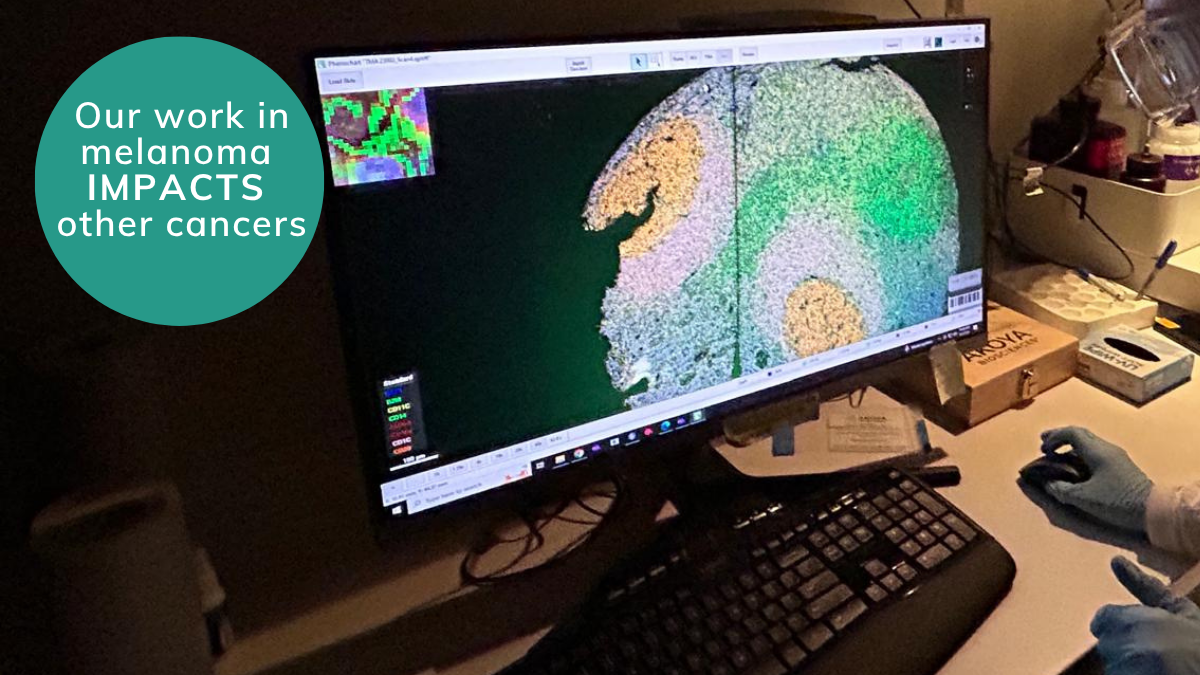
Working with tumour samples from patients treated with anti-PD-1 therapy, the MIA research team used multiplex imaging to map not only which cells were present, but exactly where each one sat in relation to the melanoma cells around it.
The pattern was clear. Patients who responded to treatment had significantly more cytotoxic T cells – the immune system’s killer cells – within 20 micrometres, or touching distance, of a melanoma cell. Twenty micrometres is about one-fifth of the width of a human hair, and in cellular terms that is close enough to make contact. Patients whose immune cells were present but remained at a distance, stranded at the margins of the tumour, fared less well. The proximity of immune cells to tumour cells, not simply their abundance, was associated with response and longer progression-free survival.
The same team later confirmed the pattern in the adjuvant setting, going one step further to show it’s not just distance between immune and tumour cells, but also the type of killer T cell in the tumour. The team found that in patients with regional stage III melanoma, those whose tumours contained a specific type of tumour-resident CD39+ T cells positioned close to melanoma cells were significantly more likely to remain recurrence-free after immunotherapy.
“Density tells you that the immune system has arrived. It does not tell you that they are right type of T cell nor that they are getting into contact with melanoma cells.” said Associate Professor James Wilmott, senior author on the study. “Once we mapped the tissue cell by cell rather than counting cells without context, the spatial relationship emerged as the more informative variable. A CD8+ T cell, in particular tumour resident T-cells within 20 micrometres from a melanoma cell is positioned to do something. One sitting at the invasive margin, however many of them there are, is not as effective.”
Associate Professor Ines Pires da Silva, medical oncologist and co-author on the study, said the value of that distinction is what it offers before treatment begins. “It is measurable, it is reproducible, and it improved our ability to predict who would respond. For a patient, that is the important question.”
The work was led by Dr Tuba Gide, with Associate Professor Wilmott as senior author, alongside Professor Georgina Long AO and Associate Professor Pires da Silva, and was published in OncoImmunology.
The same spatial approach has since helped explain why adolescent and young adult melanoma patients respond differently to immunotherapy than older adults. In younger patients suppressive T-cells can form a barrier in the tumour, preventing the infiltration of the killer T cells.
Five years later, the same principle in breast cancer
In 2024, a team at the Netherlands Cancer Institute reported results from the BELLINI trial, in which women with early-stage triple-negative breast cancer received neoadjuvant nivolumab, an anti-PD-1 drug, with or without ipilimumab, before surgery. The researchers looked for features that separated the women whose immune systems switched on from those whose did not.
One of the strongest signals was the distance between tumour cells and CD8+ T cells before treatment – the closer the cells were, the more likely the patient was to respond. The measurement, the cell type, the drug class and the principle were all the same. The cancer was different.
Why this matters
Two tumour types, patient samples from two continents, five years apart, and the same biological rule. That is what gives a finding its weight. A result confirmed in a second disease is no longer a quirk of melanoma. It is a property of how the immune system fights cancer.
Melanoma has long been a proving ground for immunotherapy. Ipilimumab was first approved in melanoma, followed by pembrolizumab and nivolumab. Neoadjuvant immunotherapy – giving treatment before surgery rather than after – was also pioneered and established in melanoma and is now being adopted in lung, bladder and breast cancers. Each of these breakthroughs first demonstrated in melanoma have gone on to shape treatment across other cancers. Spatial biology is now following the same path.
“Every melanoma patient I see wants an answer to the same question. It is whether this will work for them,” said Professor Georgina Long AO, medical oncologist and Medical Director of Melanoma Institute Australia. “Narrowing that uncertainty is not an incremental gain. It is the difference between months of a treatment that was never going to help and moving straight to one that might. What is remarkable here is that the principle did not stay in melanoma. It is now shaping how our colleagues think about breast cancer. That is what melanoma research does. We test the biology first, and the benefit extends.”
References
Gide TN, Silva IP, Quek C, et al. Close proximity of immune and tumor cells underlies response to anti-PD-1 based therapies in metastatic melanoma patients. OncoImmunology. 2019;9(1):1659093. https://doi.org/10.1080/2162402X.2019.1659093
Attrill GH, Owen CN, Ahmed T, et al. Higher proportions of CD39+ tumor-resident cytotoxic T cells predict recurrence-free survival in patients with stage III melanoma treated with adjuvant immunotherapy. Journal for ImmunoTherapy of Cancer. 2022;10(6):e004771. https://doi.org/10.1136/jitc-2022-004771
Bai X, Attrill GH, Gide TN, et al. Stroma-infiltrating T cell spatiotypes define immunotherapy outcomes in adolescent and young adult patients with melanoma. Nature Communications. 2024;15:3014. https://doi.org/10.1038/s41467-024-47301-9
Quek C, Pratapa A, Bai X, et al. Single-cell spatial multiomics reveals tumor microenvironment vulnerabilities in cancer resistance to immunotherapy. Cell Reports. 2024;43(7):114392. https://doi.org/10.1016/j.celrep.2024.114392
Nederlof I, Isaeva OI, de Graaf M, et al. Neoadjuvant nivolumab or nivolumab plus ipilimumab in early-stage triple-negative breast cancer: a phase 2 adaptive trial. Nature Medicine. 2024;30:3223-3235. https://doi.org/10.1038/s41591-024-03249-3