As neoadjuvant immunotherapy continues to transform outcomes for people with melanoma and other cancers, accurately and efficiently measuring how well these treatments work has never been more important. Two recent papers published in the Annals of Oncology (February 2026) journal provide vital advances in this area. Together, they show that assessing tumour response after neoadjuvant (pre-surgery) immunotherapy can be both more efficient and more consistent across cancer types, without compromising accuracy.
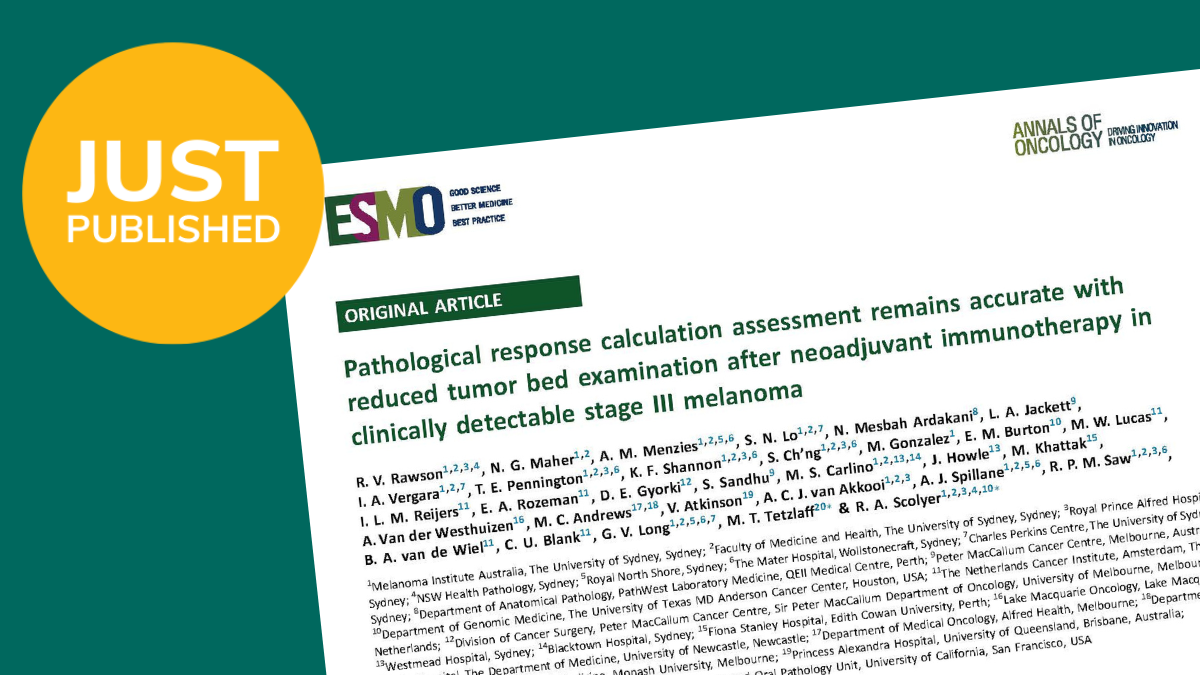
Dr Rob Rawson, a pathologist and member of the Melanoma Institute Australia faculty, was first author of the paper Pathological response calculation assessment remains accurate with reduced tumour bed examination after neoadjuvant immunotherapy in clinically detectable stage III melanoma. This study focused on patients with resectable macroscopic Stage III melanoma who received neoadjuvant immunotherapy. Traditionally, pathologists assess the pathological response to treatment by examining large areas of the tumour bed – the tissue where the tumour was located – after surgery to determine how much cancer remains. This process can be time-intensive and resource-heavy.
Pathological response is measured as a percentage residual viable tumour (%RVT) and this microscopic result is one of the strongest indicators of what should happen in the next stage of treatment for Stage III melanoma.
The study assessed the impact on %RVT when evaluating less tumour bed (TB) than recommended by the initial International Neoadjuvant Melanoma Consortium (INMC) protocol. Examining 134 patient specimens, the % RVT of each case was recalculated using seven modified protocols and compared with % RVT obtained under INMC protocol. Next, a simulation study was carried out recalculating %RVT by random sampling 50%, 33% and 25% of TB slides per specimen.
The findings demonstrated that reducing the amount of TB bed examined does not diminish the accuracy of pathological response assessment. In other words, pathologists can examine less tissue while still reliably determining how well a patient has responded to treatment. The refined approach results in high accuracy and significant reduction in the number of slides examined.
This finding has practical implications – it can streamline workflows, reduce burden on pathology services, and potentially speed up the delivery of results to clinicians and patients – without sacrificing accuracy.
“As neoadjuvant therapy is now becoming the standard of care in stage III melanoma with a significant increase in examination of these specimens expected in the pathology community, this work is crucial as it provides confidence to both pathologists and clinicians that a revised protocol which allows for a reduced amount of tumour bed examined for the largest cases, still provides accurate and timely prognostic information to clinicians and their patients” – Dr Rob Rawson
A second paper Updated pan-tumour guidelines for neoadjuvant scoring of pathologic response: a joint SITC and INMC effort presents updated guidelines for scoring pathological response across different cancer types, developed through a collaboration between international experts. Leaders in pathology, oncology, and surgery, including those from the Society for Immunotherapy of Cancer (SITC), the International Neoadjuvant Melanoma Consortium (INMC) and Melanoma Institute Australia convened to develop updated consensus guidelines for pathologic response assessment. These guidelines aim to standardise how response is measured across different cancer types treated with neoadjuvant therapies, including immunotherapy.
A key strength of the updated guidelines is their emphasis on consistency and comparability. A revised and standardised approach to tissue submission is recommended, including total submission of tumours ≤3 cm in size for microscopic tissue analysis. Additional guidance is provided for larger tumours. Pathologic response is quantified through assessments of %RVT, necrosis, and regression. Descriptions of histologic features to be scored are provided together with a standardized reporting template. Recommendations regarding collecting additional key datapoints are also made, to allow continued extended validation of this pan-tumour approach.
By aligning definitions, scoring systems, and reporting methods, the guidelines enable clinicians and researchers to better compare outcomes across clinical trials and cancer types. This is particularly important as neoadjuvant approaches expand beyond melanoma into a wide range of cancers.
Together, these studies highlight a shift toward more efficient and harmonised approaches to evaluating treatment response. The melanoma-specific findings provide confidence that streamlined assessment methods are reliable, while the broader guidelines ensure that these assessments are applied consistently across the oncology community.
These two papers mark an important step forward in how we measure the impact of neoadjuvant immunotherapy. They show that we can simplify pathological assessment without losing accuracy and standardise approaches across cancers. Ultimately, this means faster, more consistent insights into how treatments are working – helping clinicians make better decisions and supporting continued progress toward improved patient outcomes.