
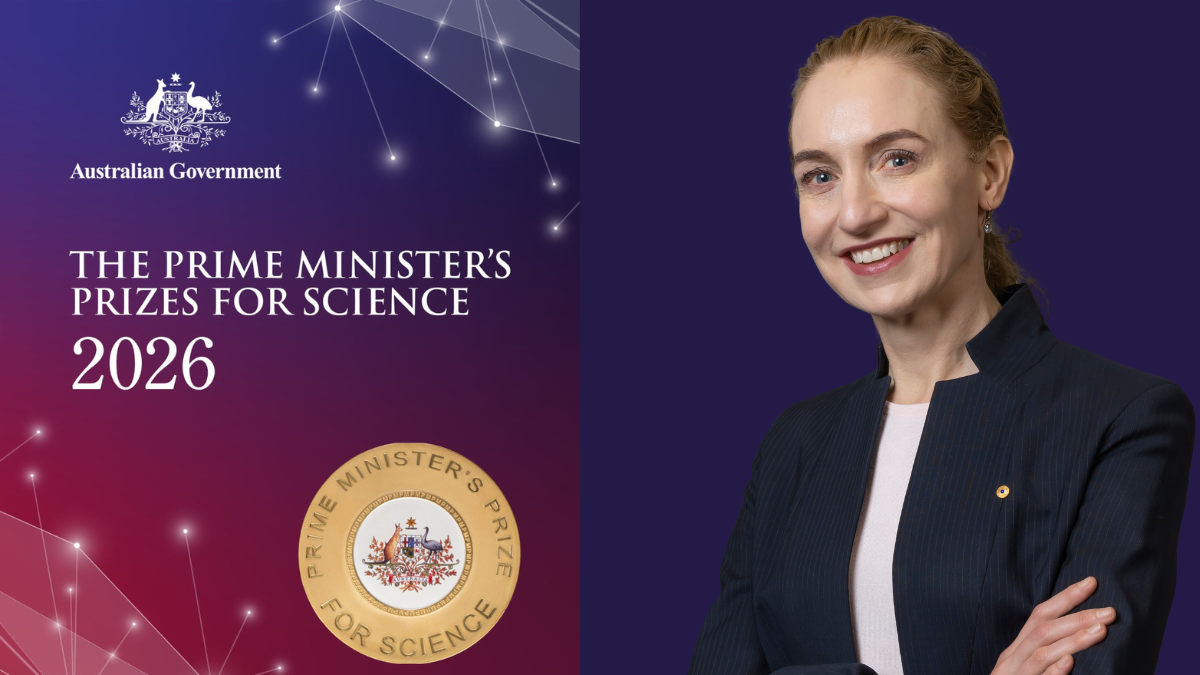
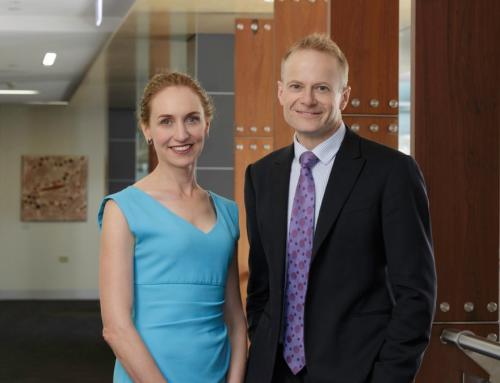
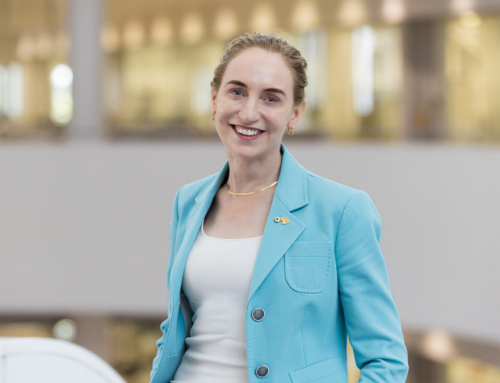
Professor Georgina Long AO has received the 2026 Prime Minister’s Prize for Science, one of the nation’s top scientific research honours, for pioneering research that has transformed the treatment of melanoma, and influencing treatment approaches across the broader field of oncology.
The Prime Minister’s Prizes for Science are Australia’s most prestigious national science prizes. They recognise Australian scientists, innovators, primary and secondary science teachers, and Aboriginal and Torres Strait Islander knowledge holders whose contributions shape everyday life. The Prizes recognise individuals and teams whose work delivers substantial economic, health, social, cultural and environmental benefits to Australia and the world, while shining a spotlight on role models who inspire future generations.
2026 Prime Minister’s Prize for Science – Professor Georgina Long
Professor Long, Medical Director of Melanoma Institute of Australia and Chair of Melanoma Medical Oncology & Translational Research at The University of Sydney, is a world-renowned oncologist at the forefront of immunotherapy and precision oncology. Her original, in-depth clinical and translational research led to the first highly effective drug therapies for melanoma and a paradigm shift in cancer treatment.
“What motivates me in life is to make a positive contribution to society and this planet. I want to do the most I can, with the dedicated and talented people I work with, to make a difference to many. That’s why I chose to dedicate my career to cancer and melanoma, Australia’s cancer.” – Prof Georgina Long
Professor Long led clinical and scientific breakthroughs that improved survival 10-fold for people with stage IV disease and 24-fold for those with brain metastases. Historically, patients with brain metastases faced an average survival of just 4 to 6 months and were excluded from clinical trials. Professor Long challenged that thinking. Today, around half of patients with brain metastases are alive after 7 years with no active melanoma, a durable long-term response and a high quality of life. Her research has fundamentally changed the outlook for people with advanced melanoma, transforming clinical practice and shaping international treatment guidelines.
“Georgina’s courage and tenacity in pursuing answers to some of the most difficult questions in cancer research have helped transform the treatment of melanoma and reshape oncology, giving hope to patients with cancers once considered extraordinarily difficult to treat.” – Professor Mark Scott AO, University of Sydney Vice-Chancellor and President
More recently Professor Long led neoadjuvant (before surgery) immunotherapy trials, which has led to major improvements in stage III melanoma survival. In 2025, neoadjuvant immunotherapy was approved and subsidised for all Australians. She and her team are also working on revolutionising clinical trial methodology by accelerating the use of biomarkers to personalise clinical trials, developing predictive models to guide patients to the most appropriate treatment.
“I want to cure cancer; I would love for people to live well with a diagnosis of cancer; I would like to find therapeutic advances that eradicate cancer; and, most of all, I’d love to be able to prevent cancer from happening in the first place.” – Prof Georgina Long
Her work represents a world-class model of integrated cancer care and research bringing discoveries from the laboratory directly to patients who need them most, and influencing treatment approaches across the broader field of oncology.
”Receiving this prize acknowledges what has been achieved, and it spurs me on to achieve more. It inspires me to stay resilient and keep going.” – Prof Georgina Long
Recognising all 2026 Prime Minister’s Prizes for Science recipients
Prime Minister’s Prize for Science
Professor Anthony Thomas AC, based out of Adelaide University, is one of the world’s most esteemed subatomic theorists, whose discoveries over more than five decades have reshaped how humanity understands matter, antimatter, dark matter and neutron stars helping unlock the mysteries of the cosmos and establishing Australia as a player in global physics.
Prime Minister’s Prize for Innovation
Professor Mark Smythe, operating out of the University of Queensland’s Institute for Molecular Bioscience, has translated Australian research into globally approved medicines for psoriasis and blood disorders, co-founding six biotech companies and building Australia’s largest university biopharmaceutical spin-out.
Frank Fenner Prize for Life Scientist of the Year
Professor Asha Bowen’s community-led research delivered the first significant reduction in childhood skin infections in more than 50 years, transforming the prevention of skin infections and acute rheumatic fever in Aboriginal children. She conducts her work at The Kids Research Institute Australia, Perth Children’s Hospital and University of WA.
Malcolm McIntosh Prize for Physical Scientist of the Year
Associate Professor Fengwang Li has pioneered renewable electrochemical research at The University of Sydney that converts waste emissions into clean energy and sustainable manufacturing materials, accelerating Australia’s transition to a net-zero circular economy. He solved the ‘carbonate paradox’ in carbon dioxide recycling with a world-record 77 per cent carbon efficiency, and is advancing ammonia as a clean energy carrier to power heavy industry.
Prize for New Innovators
Dr Joseph J. Richardson co-invented and commercialised Metal-Phenolic Network nanocoatings. He translated this breakthrough into two commercial ventures: SWIFF, creating consumer hygiene products used by more than 1 million people globally and Bionica, pioneering sustainable agricultural coatings that can cut pesticide use by up to 8,000-fold.
Prime Minister’s Prize for Aboriginal and Torres Strait Islander Knowledge Systems
Professor Christopher Matthews transformed Australian STEM education by developing the Goompi Model, demonstrating that Aboriginal and Torres Strait Islander knowledge systems are rigorous mathematical frameworks, embedding 138 Indigenous Knowledge Systems in the Australian Mathematics Curriculum and inspiring over 230,000 students to recognise themselves as mathematicians.
Prime Minister’s Prize for Excellence in Science Teaching in Primary Schools
Dr Gabrielle Oslington is a primary school STEM teacher at Arden Anglican School in New South Wales, who has spent 15 years proving that serious scientific thinking, data literacy, and mathematical reasoning do not require high-tech secondary labs – it can begin in primary education with everyday phenomena such as a playground sandpit or a supermarket apple.
Prime Minister’s Prize for Excellence in Science Teaching in Secondary Schools
Nicolette (Nicci) Wheaton is a secondary school STEM teacher at The Glennie School, in Toowoomba, Queensland, whose practical, inclusive teaching methods prove that academic rigour and educational accessibility go hand in hand. Over a 20-year career spanning regional public schools, distance education for isolated learners and independent education, she has dedicated her career to dismantling the barriers that often keep young women and regional students from pursuing STEM pathways.
Leave A Comment