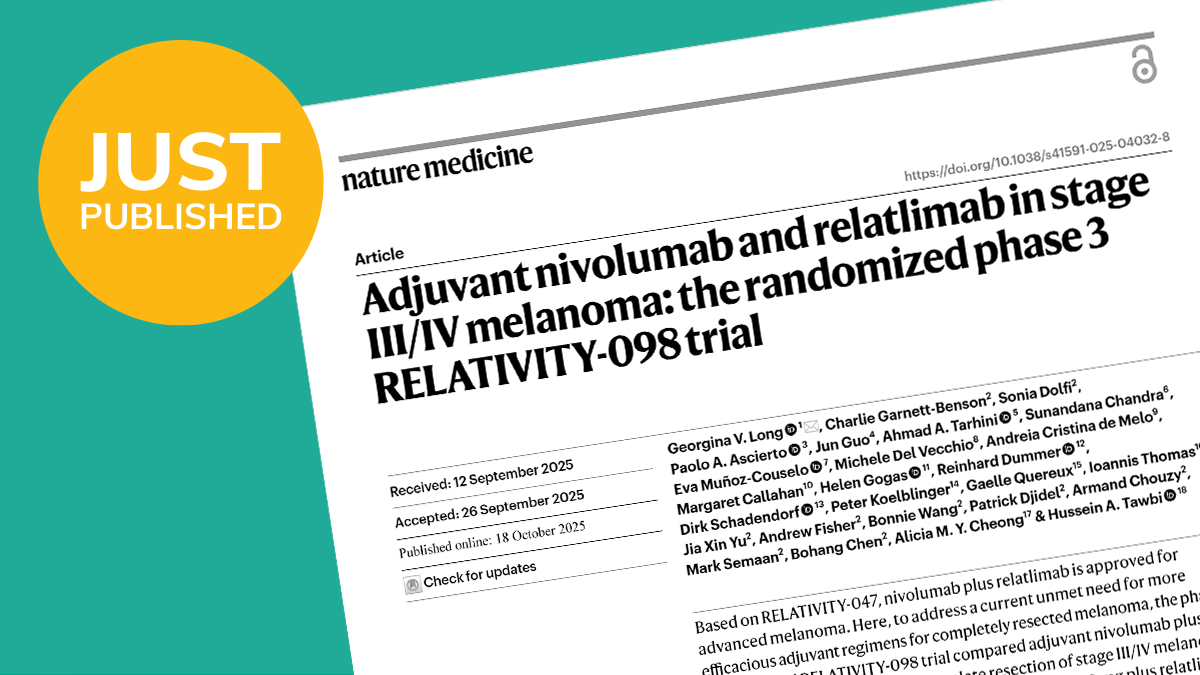
Clinical trial results published this week in the prestigious Nature Medicine provide further evidence that the presence of tumour is directly related to the effectiveness of combination immunotherapy treatment for high risk and advanced melanoma patients.
Melanoma Institute Australia Medical Director Professor Georgina Long AO, who is a global leader in drug development and immunotherapy clinical trials, is lead author for the paper, ‘Adjuvant nivolumab and relatlimab in stage III/IV melanoma: the randomized phase 3 RELATIVITY-098 trial’.
The trial involved 1,093 patients with high risk early stage melanoma from 163 hospitals and cancer centres across 24 countries. All patients had undergone surgery to remove their melanoma. Post surgery, they were randomly assigned to receive immunotherapy drugs nivolumab plus relatlimab (547 patients) or nivolumab alone (546 patients).
Clinical results showed no added benefit in the adjuvant (post-surgery) setting for the combination of nivolumab plus relatlimab, over nivolumab alone.
‘This is what we call a negative trial, however the results are critical in furthering our understanding of immunotherapy and the drivers of different response in the neoadjuvant (pre-surgery) and adjuvant (post-surgery) settings,’ Professor Long said.
‘By comparing results of neoadjuvant and adjuvant trials using the same combination immunotherapy drugs, we have shown a clear link between response and the presence of tumour cells.
‘This scientific evidence will shape future clinical trials and cancer treatment globally,’ she said.
While the newly published adjuvant RELATIVITY-098 trial showed no clinical benefit, the same combination immunotherapy did improve progression-free survival in patients with advanced melanoma in the RELATIVITY-047 trial. This earlier study was published in the New England Journal of Medicine, with MIA’s Associate Professor Alexander Menzies as an author and Professor Long as senior author.
These results enabled further translational research to be undertaken to better understand the mechanisms behind the different outcomes, and importantly, the role the presence of tumour cells may have on the effectiveness of the combination immunotherapy.
Immune checkpoint expression on T cells in the blood and tumour was investigated to understand whether tumour (which was surgically removed in the adjuvant treatment setting) may be necessary for benefit from the addition of relatlimab.
Comparing biomarker results in resected melanoma in RELATIVITY-098 and advanced melanoma in RELATIVITY-047 suggested that the presence of tumour and associated higher levels of LAG-3+ T cells in the blood may be necessary to derive additional clinical benefit with nivolumab plus relatlimab, over nivolumab alone.
‘This provides supportive evidence that neoadjuvant, or pre-surgery combination immunotherapy is the new frontier in treatment, not only for melanoma but for other cancers too,’ Prof Long said.
‘Every clinical trial we undertake builds our knowledge and understanding in this critical area, and we remain committed to continuing to our groundbreaking work to save more lives.’