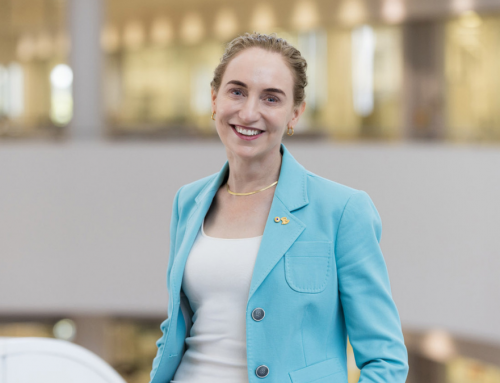
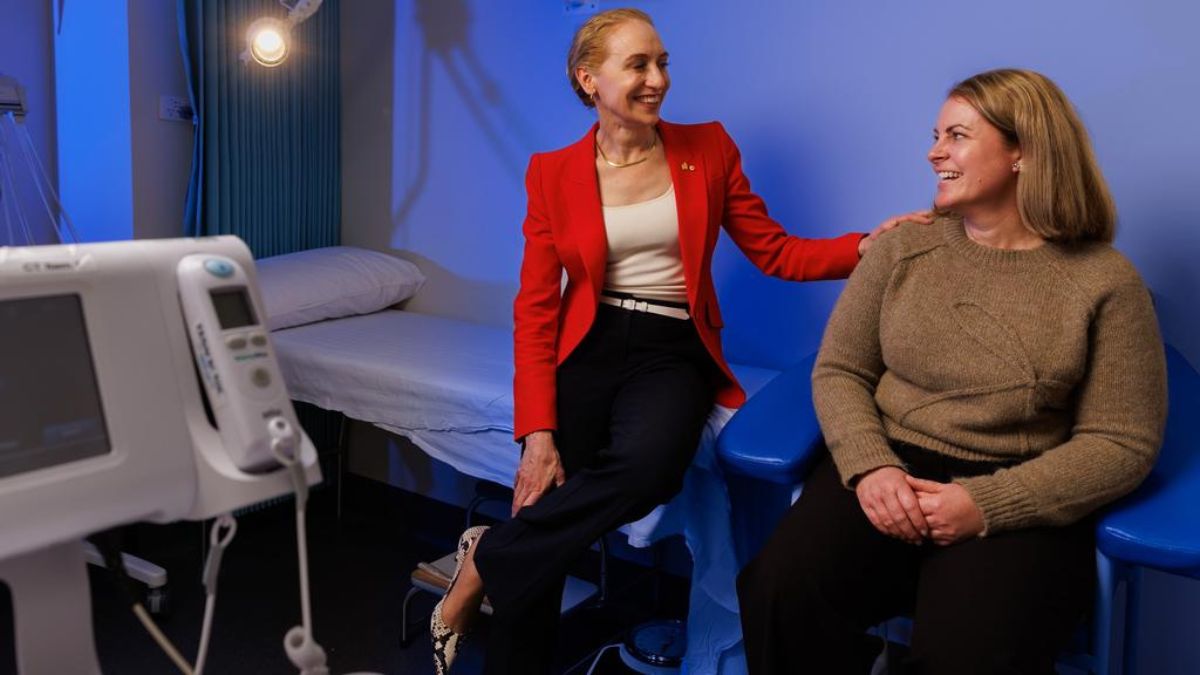
Photo by Max Mason-Hubers, The Australian
“Australia is leading the way in revolutionising cancer treatment across the globe”
– Professor Georgina Long AO Medical Director Melanoma Institute Australia, Joint 2024 Australian of the Year
The pre-surgery use of combination immunotherapy as frontline treatment for high risk melanoma was on 1 August 2025 listed on the Pharmaceutical Benefits Scheme (PBS) and subsidised for all Australian patients.
Melanoma Institute Australia (MIA) Medical Director, Professor Georgina Long AO, co-led the international NADINA clinical trial of pre-surgery combination immunotherapy for patients with high-risk Stage III melanoma with her long-time colleague and friend Professor Christian Blank from The Netherlands Cancer Institute.
‘The NADINA clinical trial proved without a doubt the life-saving impact of giving combination immunotherapy before, rather than after surgery, so it was imperative this treatment be subsidised for Australian melanoma patients as quickly as possible,’ Professor Long said.
‘This is great for melanoma and sets a benchmark for all cancers. Australia is leading the way in revolutionising cancer treatment across the globe.’
The NADINA trial was the first phase 3 trial in oncology evaluating a neoadjuvant regimen consisting of only immunotherapy. It compared neoadjuvant (pre-surgery) treatment with combination immunotherapy (ipilimumab and nivolumab) to the current standard adjuvant (post-surgery) approach with single agent immunotherapy (nivolumab).
The international trial was opened by Melanoma Institute Australia at eight Australian centres including MIA, Peter MacCallum Cancer Centre, Westmead Hospital, The Alfred, Tasman Health Care, Lake Macquarie Hospital, Fiona Stanley Hospital and Princess Alexandra Hospital. Australian patients made up a third of all those recruited globally for the trial.
Results were published in the prestigious New England Journal of Medicine, the top medical journal in the world which changes clinical practice. They showed estimated 12 month event-free survival (EFS) rates of 83.7% in the neoadjuvant arm vs 57.2% in the adjuvant arm.
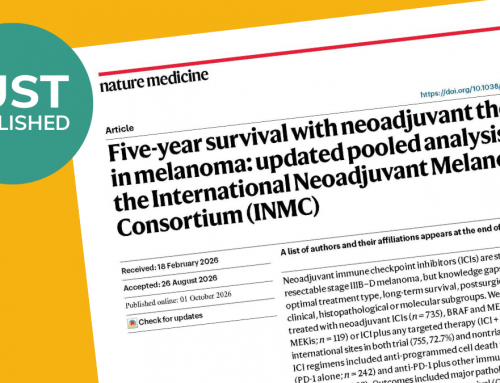
Melanoma Institute Australia’s multidisciplinary team – including medical oncologists, surgeons, pathologists radiologists and nurses – has been instrumental in trialing neoadjuvant drug therapy with its Faculty members part of the International Neoadjuvant Melanoma Consortium (INMC).
‘The multidisciplinary team at MIA, along with our patients, have led this fantastic research which establishes a new “gold standard” of care across the world. We welcome the listing of this treatment on the PBS which means all Australians may benefit from this life saving therapy,’ said MIA Faculty member and Medical Oncologist, Associate Professor Alex Menzies.
‘Our patients will benefit immensely from the PBS listing of this life-changing drug treatment, pioneering melanoma treatment world-wide,’ added MIA Faculty member and Surgical Oncologist, Associate Professor Robyn Saw. ‘It is an amazing testament to the willingness of Australian patients to participate in clinical trials, clinician researchers to push boundaries and the Australian government to support evidence based treatment.’
In 2023, NADINA was named by high impact journal Nature Medicine as one of 11 clinical trials most likely to have an impact on global medicine in the coming year.
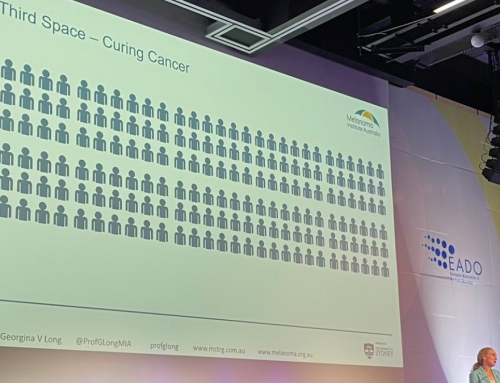
‘This phase 3 trial was the first of its kind and is one of the single biggest developments, not only in melanoma, but the whole cancer field,’ Prof Long said. ‘It has flipped the traditional ‘surgery then drugs’ rationale on its head and sets the stage and benchmark for other cancers to follow suit.’
Australia has the highest melanoma rates in the world with one person diagnosed with the disease every 30 minutes and one person dying from the disease every 6 hours.
‘NADINA shows the power of clinical trials to push science and medicine forward and my next step, with the support of an amazing team, is to later this year open a set of novel neoadjuvant combination immunotherapy trials in melanoma to push survival rates even higher,’ Prof Long said.
‘Our dedicated multi-disciplinary team at MIA remains focused on planning ahead with regards to what our next major change in practice needs to be to transform outcomes not only for melanoma patients but for patients across all cancers.
‘This includes the MIA international MSLT3 clinical trial led by Associate Professor Alexander Van Akkooi, aiming to safely reduce surgery for high risk Stage III melanoma patients who have had a good response to neoadjuvant immunotherapy. This will improve quality of life and decrease surgical intervention.’
The International Neoadjuvant Melanoma Consortium (INMC), of which Melanoma Institute Australia’s Professor Long is a founder with three colleagues from MD Anderson USA, has been awarded the 2025 Society for Immunotherapy of Cancer Collaboration Award for its work in pioneering neoadjuvant immunotherapy for melanoma. Read more.