Three studies led by researchers at Melanoma Institute Australia (MIA) are paving the way for less surgical and drug intervention for early stage melanoma patients.
A study recently published in The Journal for ImmunoTherapy of Cancer was led by MIA and had numerous MIA authors including Associate Professor Alex Menzies as senior author. The study examined whether PET imaging, which is an accurate predictor of survival in patients with advanced melanoma, can also predict pathological response or survival in the neoadjuvant (pre-surgery) setting.
Over 100 patients from five International Neoadjuvant Melanoma Consortium centres, including Melanoma Institute Australia, were involved in the study. Findings suggest that neoadjuvant immunotherapy has high FDG-PET response rates in melanoma, which associates with pathological response and survival.
These results suggest FDG-PET is an important tool for predicting immunotherapy response before surgery, potentially enabling identification of patients who don’t require surgery at all, and also those who may instead benefit from alternative systemic treatment escalation prior to surgery.
Another paper also led by MIA was published in Annals of Oncology with MIA Medical Director Professor Georgina Long AO senior author. It examined the benefit of adjuvant (or post-surgery) targeted therapy and immunotherapy in patients with Stage IIIA melanoma.
Stage IIIA melanoma has a modest risk of recurrence, and patients with resected disease have traditionally been underrepresented in clinical trials of adjuvant drug therapy.
The multi-centre retrospective study involved 628 patients from 34 centres across Australia, Europe and the USA. The study found post-surgery immunotherapy did not significantly improve recurrence free survival or distant metastasis-free survival in these patients. Post-surgery targeted therapy did however appear to have some promising benefits.
‘These results are important because they pave the way for potentially less drug intervention for these patients,’ said Professor Georgina Long AO. ‘More detailed studies are now needed in this patient group.’
A paper recently published in The Lancet, with Prof Long an author, investigated whether circulating tumour DNA (ctDNA) measurements, which assess minimal residual disease, could predict survival outcomes during adjuvant targeted therapy in Stage III melanoma. The paper suggests additional studies using ctDNA measurements to guide therapeutic interventions might lead to improvements in the management of resected stage III melanoma.
‘These three papers are all examples of the body of research underway at Melanoma Institute Australia to ensure patients receive treatment with optimum benefit,’ Professor Long said. ‘Sometimes less is more when it comes to medical intervention, with flow-on benefits for not only patients but also the national health budget. These studies are vital in helping us determine optimum drug therapy and surgery for these groups of patients.’
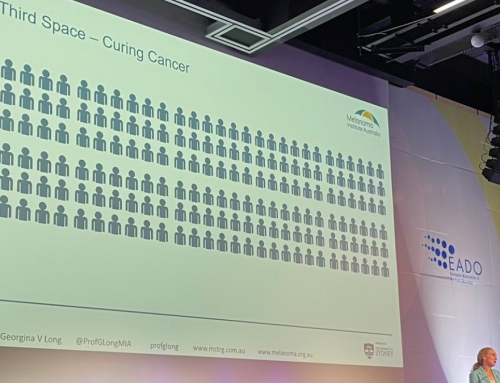
Photo by Event Photos Australia.